Pinoy Driver

LTO Valid ID List: The Complete List of Valid ID in the Philippines for a Driver’s License and Student Permit

The Complete List of Valid ID in the Philippines: LTO-Accepted, Government-Issued IDs for Your Student Permit and Driver’s License

If you’re applying for an LTO student permit, renewing your driver’s license, or just need one government issued document that every Philippine office recognizes, this is the complete list of valid IDs LTO and other government agencies in the Philippines accept in 2026 — primary IDs, secondary IDs, and the handful of documents (like a school ID) that don’t make the cut.

Why LTO Asks for a Valid ID Before Issuing a Student Permit or Driver’s License

Every LTO transaction — a first-time student permit, a non-professional or professional driver’s license application, or a license renewal — starts with the same base requirement: proof of valid identification with your photo and signature, confirming you’re who your application says you are. LTO, short for the Land Transportation Office, runs this identity verification step by cross-referencing your ID against your Land Transportation Management System (LTMS) account before it lets you sit for the written exam or book your appointment, so bringing the wrong kind of ID is one of the most common reasons applicants get turned away at the branch. Your valid ID is only one line item, too — you’ll also need a medical certificate and a completed application form before LTO processes anything. If you haven’t started your student permit application yet, our LTO Student Permit Requirements guide walks through the full checklist alongside this one.

What Counts as a Valid ID in the Philippines? Primary ID vs. Secondary ID, Explained

Not every ID card in your wallet counts as a valid ID in the Philippines for a formal government transaction. Most agencies, banks, and LTO branches sort acceptable IDs into two tiers, and primary IDs tend to get accepted across the widest range of government transactions:

  • Primary ID — government-issued, bears your photo and your signature, and is generally accepted on its own without needing to be paired with anything else. A Philippine passport, driver’s license, UMID, PRC ID, and PhilSys National ID all fall into this category.
  • Secondary ID — either missing a photo, missing a signature, or conditionally accepted, and often needs to be presented alongside a second ID or other supporting documents. A TIN ID, NBI clearance, and (for some institutions) a PhilHealth ID typically fall here.

Where this gets confusing: this primary and secondary IDs framework isn’t identical across every institution. The Social Security System’s own published guide, for example, classifies the LTO Student Permit itself as an acceptable secondary ID and treats items like the Postal ID or PhilHealth ID differently than most banks do — so if an office’s specific requirement list disagrees with the general breakdown below, always defer to what’s posted at that branch or counter.

The Complete List of Valid IDs LTO Accepts

Based on LTO’s published requirements for student permit and driver’s license transactions, here’s the complete list of valid IDs — any one of the following works as a government ID for your application, presented as an original plus a photocopy, with your photo and signature both showing:

  • Philippine passport
  • PhilSys National ID (PhilID or ePhilID)
  • SSS ID / UMID Card
  • Philippine Identification Card
  • PhilHealth ID
  • TIN Card (Tax Identification Number)
  • Postal ID
  • Senior Citizen ID
  • Voter’s ID or Voter’s Certification
  • PRC ID (Professional Regulation Commission)
  • IBP ID (Integrated Bar of the Philippines, for lawyers)
  • Solo Parent ID
  • DSWD Certification
  • Home Development Mutual Fund (Pag-IBIG) ID
  • GSIS eCard
  • Seaman’s Book / Seafarer’s Identification and Record Book
  • GOCC-issued ID
  • OWWA ID (for OFWs)
  • NCDA ID (for persons with disabilities)

That’s a wide net — wider than what most first-time applicants expect — and it’s recognized at LTO branches and most other government offices, government agencies, and government services nationwide, useful for various transactions well beyond just your license or permit. Still, LTO doesn’t accept every ID equally. A handful of common IDs (covered further down) either need to be paired with something else or aren’t accepted at all.

Philippine Passport, UMID, and SSS: The Most Widely Accepted Primary IDs

Of everything on the list above, three IDs get accepted almost everywhere, LTO included, with zero friction:

Philippine passport. Issued by the Department of Foreign Affairs (DFA), a Philippine passport is the single most universally accepted primary ID in the country — it’s built for international travel, but it works just as well at an LTO counter as it does at immigration. If you don’t have one yet, budget extra lead time; DFA appointment slots can book out weeks in advance.

UMID (Unified Multi-Purpose ID). A joint project of the Social Security System (SSS), GSIS, PhilHealth, and Pag-IBIG, the UMID doubles as an ATM card and identification card if you enroll it with a partner bank. If you’re already an SSS member, this is usually the fastest primary ID to get, since the enrollment happens through SSS branches you may have already visited.

SSS ID. Older SSS-issued cards (before the UMID rollout) still function as a valid primary ID for most transactions, LTO included, as long as the photo and signature are legible.

Postal ID and PhilHealth ID: Everyday Government-Issued ID Options

Postal ID, issued by PHLPost, is one of the more accessible government-issued ID options because you don’t need an existing government record to apply — proof of address and a birth certificate are usually enough. The current PVC version carries a photo, signature, and barcode, which is why most banks and LTO branches treat it as a primary ID; older paper versions are more likely to get treated as secondary. Validity is commonly cited at around three years, though this varies by source and by which version you’re holding — confirm the expiry printed on your specific card.

PhilHealth ID, issued by the Philippine Health Insurance Corporation, comes in a free basic version and a PVC card version (for a small fee). Because the free version doesn’t always carry a signature, some institutions treat it as a secondary ID rather than primary — bring a second ID as backup if a PhilHealth ID is the only government-issued ID you’re carrying.

Senior Citizen ID and Solo Parent ID: Valid Government-Issued ID for Senior Citizens and Solo Parents

Two IDs exist specifically to formalize benefits for two groups the law protects: senior citizens and solo parents.

Senior Citizen ID is issued free of charge by your city or municipality’s Office of Senior Citizen Affairs to Filipino citizens 60 and above, and functions as a valid government-issued ID nationwide, with no expiration.

Solo Parent ID, issued under the Expanded Solo Parents Welfare Act (RA 11861) through your local government unit’s social welfare office, is valid for one year from release and must be renewed annually to keep both the ID and its accompanying benefits active. Because it’s tied to a specific benefits law rather than a general-purpose identity system, some counters — LTO branches included — treat it as a valid government-issued ID on its own, while others prefer to see it paired with a second document; bring a backup ID if you’re using it as your primary proof of identity.

PRC ID and IBP ID (Integrated Bar of the Philippines): Valid ID for Licensed Professionals Under the Professional Regulation Commission

If you’re a licensed professional, your credential doubles as one of the strongest primary IDs available:

PRC ID, issued by the Professional Regulation Commission to every licensed professional in the Philippines — engineers, nurses, teachers, accountants, and dozens of other regulated professions — is treated as a primary ID almost everywhere, largely because it requires passing a licensure exam to obtain.

IBP ID, issued by the Integrated Bar of the Philippines specifically to licensed lawyers, works the same way for members of the legal profession, and is typically renewed annually alongside IBP membership dues.

Philippine Identification (PhilSys National ID): The Newest Addition to the List of Valid IDs

The Philippine Identification System, or PhilSys, is the government’s unified national ID program, and its output — commonly called the National ID or PhilSys ID — has quickly become one of the most widely accepted IDs on this entire list. Every registered Filipino gets a unique, permanent identification number called your PhilSys Number (PSN) and a physical PhilID card; you can also request a digital ePhilID in the meantime, and per the Philippine Statistics Authority (PSA), which administers PhilSys, the ePhilID carries the same legal validity and functionality as the physical card. National government agencies, LGUs, banks, and transportation authorities — LTO among them — are required to honor it as an official government-issued identification document, which makes it one of the safest single IDs to lead with at any counter, LTO included.

School ID and Barangay ID: Why These Aren’t Widely Accepted as a Valid ID

Two IDs cause more confusion than any others on this page, mostly because people assume they’ll work everywhere:

School ID. A school ID alone is not accepted for LTO transactions, full stop — it’s one of the most common reasons a first-time student permit applicant gets sent home to find another document. Schools aren’t government agencies, so a school-issued card doesn’t carry the same weight as a government-issued ID, no matter how official it looks. If a school ID is the only ID you have, see the next section on what to bring instead.

Barangay ID. A Barangay ID or barangay certification is useful for local, barangay-level transactions, but it isn’t universally accepted for national government transactions the way a PRC ID or passport is — LTO, DFA, and most banks generally won’t accept a barangay ID as your sole valid ID, though some local government counters will. Treat it as a supporting document rather than your primary ID.

What If You Don’t Have Any Valid ID Yet? First-Time and Student Permit Applicants

This is the exact spot where most 16- and 17-year-old first-time student permit applicants get stuck: no driver’s license (that’s what they’re applying for), no TIN, no SSS record, no passport. If a valid ID is required for employment or school and you don’t have a job or a passport yet either, start with your PSA birth certificate — it’s the base document nearly every other ID on this page is built from — plus a parent or guardian’s valid ID and a notarized consent if you’re a minor. From there, applying for a PhilSys National ID is usually the fastest way to get a standalone government-issued ID of your own, since PhilSys registration only needs your birth certificate and doesn’t require you to already hold another ID; hang on to the official receipt from that registration in case your branch asks for it while your physical card is still processing. Our LTO Student Permit Requirements guide covers the full document checklist for minors and first-time applicants side by side.

Valid ID for OFWs, Seafarers, and Foreign Nationals in the Philippines

A handful of IDs on this list exist for specific groups:

OWWA ID. Issued by the Overseas Workers Welfare Administration to active OFWs, this ID is widely accepted for both government and private transactions involving Filipino workers abroad and their dependents.

Seaman’s Book. Formally the Seafarer’s Identification and Record Book, this is a certificate issued by the Maritime Industry Authority (MARINA) to licensed seafarers, and it’s treated as a primary ID nationwide.

Immigrant Certificate of Registration (ICR). For foreign nationals who’ve been granted permanent resident status in the Philippines, the Bureau of Immigration issues an ICR — distinct from the Alien Certificate of Registration (ACR I-Card) issued to non-immigrant foreigners staying long-term. Either document functions as a valid government-issued ID for a foreign resident’s transactions in the Philippines, LTO included, though a foreign applicant for a Philippine driver’s license will also need to show proof of Philippine residency alongside it.

If none of the above applies to you and you’re a Filipino citizen with none of the documents on this page, bring another valid ID you do have — even a secondary-tier one — and ask your specific LTO branch which combination they’ll accept; requirements can vary slightly by branch. This applies the same way whether you’re a professional and non-professional license applicant — LTO doesn’t relax its ID rules for one license type over the other.

Voter’s ID Status in the Philippines (2026 Update)

If you’re hoping to use a Voter’s ID as your valid ID, here’s the current state of things: the Commission on Elections (COMELEC) has not printed new Voter’s IDs since it suspended issuance to run all roughly 50 million registered voters through its Automated Fingerprint Identification System (AFIS) for de-duplication. As of an August 2026 government advisory, printing had not yet resumed, and no restart date had been announced. If you already hold a previously issued Voter’s ID, it remains a valid secondary ID for most transactions; if you don’t, ask COMELEC for a Voter’s Certification instead — it serves the same identity-confirmation purpose for now.

Related LTO Guides for Your Student Permit and Driver’s License

This page covers the identification piece — for the rest of your application, Pinoy Driver’s other LTO guides go deeper on each step, and together make up a comprehensive list of everything a first-time or renewing applicant needs:

  • LTO Student Permit Requirements — the full document checklist, eligibility rules, and fees for your first LTO transaction.
  • Non-Professional License Requirements — what to bring, including your valid ID, for a non-professional driver’s license.
  • LTO Driver’s License Requirements — the pillar guide covering every license type’s requirements side by side.
  • How to Get a New LTO Driver’s License — the complete first-timer’s walkthrough, from student permit to license.
  • LTO Fees 2026 — every fee tied to the transactions covered on this page.
  • LTO Driver’s License Renewal — what changes about your ID requirements when you’re renewing instead of applying fresh.
  • LTO Non-Pro to Pro License Requirements — comparing requirements if you’re upgrading your license type.

Frequently Asked Questions

What is the complete list of valid IDs accepted by LTO?

LTO accepts a Philippine passport, PhilSys National ID, SSS ID/UMID, PhilHealth ID, TIN Card, Postal ID, Senior Citizen ID, Voter’s ID or Certification, PRC ID, IBP ID, Solo Parent ID, DSWD Certification, Pag-IBIG ID, GSIS eCard, Seaman’s Book, GOCC-issued ID, OWWA ID, and NCDA ID, presented as an original plus photocopy with your photo and signature visible.

What’s the difference between a primary ID and a secondary ID in the Philippines?

A primary ID is government-issued, carries both your photo and signature, and is generally accepted on its own — a passport, driver’s license, UMID, or PhilSys ID, for example. A secondary ID is usually missing one of those features or is conditionally accepted, and often needs to be paired with a second ID or supporting document, like a TIN ID or NBI clearance.

Is a school ID a valid ID for LTO transactions?

No. A school ID alone is not accepted for LTO transactions, since schools aren’t government agencies. First-time applicants without any other ID should start with a PSA birth certificate and apply for a PhilSys National ID instead.

Is the Voter’s ID still being issued in the Philippines?

Not currently. COMELEC suspended new Voter’s ID printing to run registered voters through its biometric verification system, and as of an August 2026 advisory, no resumption date had been announced. Previously issued Voter’s IDs remain valid; new registrants can request a Voter’s Certification instead.

What if I don’t have any valid ID yet for my student permit application?

Start with your PSA birth certificate plus a parent or guardian’s valid ID and notarized consent if you’re a minor, then apply for a PhilSys National ID — it only requires your birth certificate to register and gives you a standalone government-issued ID for future transactions, including your student permit.

The Bottom Line

The complete list of valid IDs LTO and other Philippine government agencies accept is longer than most first-time applicants expect, but it isn’t unlimited — a school ID or, in most cases, a barangay ID alone won’t cut it. Lead with a primary ID like a passport, UMID, PRC ID, or PhilSys National ID whenever you have one, and if you’re starting from zero, your PSA birth certificate is the document everything else on this comprehensive list gets built from.

Tagged with: ,
Posted in Advice, Driver's license, LTO Processes & Procedures

Types of Drivers License Issued by the LTO in the Philippines 2026

Types of Drivers License Issued by the LTO in the Philippines

Every driver’s license in the Philippines falls into one of three categories, and knowing which one applies to you is the first real step in getting one. This guide is for every driver in the Philippines — Filipinos and permanent residents of the Philippines who would like to understand exactly which type of license applies to them, and what it takes for Filipinos to operate vehicles legally, from a motorcycle to a public utility vehicle. Here’s a breakdown of the types of driver’s license the LTO issues, who qualifies for each, and what the license application process actually looks like from student permit to professional license.

Each type of license has its own qualifications, its own restriction codes, and its own varying processes of its application — a student permit isn’t a license to drive on your own, a non-professional license lets you drive your own or a family member’s car, and a professional license is what you need if driving is how you earn a living. Getting the wrong one, or assuming your license covers a vehicle it doesn’t, is one of the more common — and avoidable — mistakes new motorists make.

What Is a Driver’s License in the Philippines?

A driver’s license is the government’s proof that you’re qualified and legally permitted to operate a motor vehicle on public roads. In the Philippines, it’s issued by the Land Transportation Office (LTO) under the authority of Republic Act No. 4136 (the Land Transportation and Traffic Code) and, more recently, Republic Act No. 10930, which extended how long a license stays valid before it needs renewal. Whether you’re applying for the first time or renewing, your license is issued through the LTO’s online platform, the Land Transportation Management System (LTMS), at lto.gov.ph.

A license isn’t just a formality — it’s proof of your competence behind the wheel, and it’s the first thing a traffic enforcer checks if you’re flagged down. Driving without one, or driving on a license type that doesn’t cover the vehicle you’re in, counts as driving without a license under the law, regardless of how experienced a motorist you actually are. Once your license is issued by LTO, you’re able to drive a vehicle within whatever restriction codes it carries — nothing more.

The Types of License the LTO Issues

The LTO issues three main types of driver’s license, plus one permit that comes before any of them:

  1. Student Permit — for those still learning to drive and not yet allowed to drive unaccompanied.
  2. Non-Professional Driver’s License — for those who drive their own or a family vehicle, not for hire or compensation.
  3. Professional Driver’s License — for those who drive for pay: public utility vehicles, commercial vehicles, or as part of a job that requires driving.

Each is issued to a different kind of applicant, with a different qualification bar, and each carries its own restriction codes that spell out exactly which vehicles that license lets you drive.

1. Student Permit

A student permit is where every licensed driver starts. It doesn’t let you drive alone — you need to be accompanied by a licensed, non-student driver at all times — but it’s the required first step before you can apply for a non-professional or professional license.

To qualify for a student permit, an applicant generally needs to:

  • Be at least 17 years old (minors need parental or guardian consent as part of the license application).
  • Pass a written examination — a computer-based test made up of 60 random questions drawn from a larger LTO test bank, covering road signs, traffic rules, and safe driving practices. The exam can either be in English or Filipino, depending on the applicant’s preference.
  • Present a medical certificate from an LTO-accredited clinic confirming basic physical and visual fitness to drive.
  • Submit a valid government-issued ID, plus a photocopy, for LTMS verification.
  • Pay the applicable fee and receive your Official Receipt as proof of the transaction.

A student permit typically comes with its own validity period rather than the full 10-year validity period given to a non-professional or professional license, so check your specific expiry date in LTMS before it lapses.

2. Non-Professional Driver’s License

A non-professional license is what most first-time drivers eventually convert their student permit into. It lets you legally drive a private vehicle, or drive a motor vehicle you own or borrow, for personal use, but not for hire, and not as a public utility vehicle.

Requirements for a non-professional license generally include:

  • Holding a valid student permit for the required period before you’re eligible to apply.
  • Passing both the written examination and a practical driving exam administered at an LTO-accredited driving school or LTO branch.
  • A medical certificate from an LTO-accredited clinic — usually electronically transmitted straight to your LTMS record so you don’t need to bring a printed copy.
  • A negative drug test result from an LTO-accredited drug testing facility. Like the medical certificate, this is typically electronically transmitted directly to LTMS by the facility.
  • A clearance certificate from either NBI or your local police station, generally required of first-time applicants.
  • Two 2×2 pictures with white background (some LTO branches capture this digitally on-site instead, so check with your branch beforehand).
  • A valid government-issued ID and a photocopy of it.

Whether professional or non-professional, every driver’s license issued by the LTO carries at least one restriction code that spells out which vehicles you’re actually cleared to drive — a non-professional license commonly carries restriction code 1 (motorcycle) or code 2 (light four-wheeled vehicles), or both, depending on what you tested for.

3. Professional Driver’s License

A professional license is required the moment driving becomes part of how you earn money — operating a public utility vehicle (PUV), a taxi, a delivery truck, or any of the wider category of commercial vehicles used to transport people or goods for pay. It’s the license for anyone pursuing a career as a public utility driver, a trucking job, or professional chauffeur work.

To qualify, an applicant must:

  • Be at least 18 years old.
  • Already hold a valid non-professional license, since professional licenses are typically a conversion or upgrade rather than a first license.
  • Have held that non-professional license for a minimum period before converting — and this is where a lot of guides oversimplify. Depending on the restriction code and vehicle class involved, the required holding period can be as short as six months or as long as a full year, so it’s worth confirming your specific timeline with LTO or LTMS rather than assuming the “one year” rule you’ll see quoted everywhere applies to your case.
  • Submit the same core documents as a non-professional applicant — medical certificate, clearance certificate from either NBI or the local police, negative drug test result, valid ID, and photos — since professional applicants go through their own, separately verified round of these checks.
  • Pass a written examination on top of any additional practical assessment the LTO branch requires for the specific restriction code being added.

Because professional license holders are entrusted to operate a motor vehicle carrying passengers or cargo, LTO scrutiny of an applicant’s clearance, drug test, and driving record tends to be stricter than for a non-professional license application.

Restriction Codes: What Each One Means

A restriction code is what actually tells you which vehicles your license lets you drive — not the “professional” or “non-professional” label itself. Every driver’s license, professional and non-professional alike, is issued with one or more of these codes attached:

CodeVehicle type
1Motorcycle / motorized tricycle
2Vehicle with gross vehicle weight (GVW) up to 4600 kilograms (cars, SUVs, light vans)
3Automatic-transmission vehicle exceeding 4600 kilograms GVW
4Manual-transmission vehicle exceeding 4600 kilograms GVW
5Articulated automatic-transmission vehicle exceeding 4600 kilograms GVW
6Articulated manual-transmission vehicle exceeding 4600 kilograms GVW
7Special equipment for motorists who operate vehicles that weigh more than 4600 kilograms like bulldozers and other heavy construction vehicles, such as wheeled cranes and graders
8Any vehicle under codes 3–7 driven with an automatic clutch

If your license doesn’t carry the restriction code your vehicle falls under, you’re not legally cleared to drive it — even if the license itself is valid and unexpired. This is one of the most commonly misunderstood parts of the whole system: a valid license and the right restriction code are two separate boxes that both need to be checked.

How to Apply at LTO Branches

Whether you’re getting your first student permit or converting to a professional license, the LTO branches process is broadly the same, run through LTMS from start to finish:

  1. Create or log in to your LTMS account and schedule an appointment at your chosen LTO branch.
  2. Complete your medical exam and drug test ahead of your appointment where possible — both are commonly electronically transmitted directly into your LTMS record by LTO-accredited providers.
  3. Secure your clearance certificate from either NBI or your local police station, if you’re a first-time applicant.
  4. Show up for your appointment with your documents, valid ID, and photocopy in hand.
  5. Take the written examination (60 random questions, either in English or Filipino) on-site if you haven’t already passed it through LTMS.
  6. For a non-professional or professional license, complete the practical driving exam if required for your restriction code.
  7. Pay the applicable fee and receive your Official Receipt.
  8. Wait for issuance of your license — some LTO branches print on the spot, while others follow up with issuance and delivery afterward.

Processing time for issuance varies by branch, so it’s worth confirming current turnaround with your specific LTO branch before your appointment.

Requirements Checklist for Your License Application

Pulling everything together, here’s the full requirements checklist a typical applicant should expect, regardless of which of the three types of license they’re applying for:

  • Valid government-issued ID (original plus photocopy)
  • Medical certificate from an LTO-accredited clinic
  • Negative drug test result from an LTO-accredited drug testing facility
  • Clearance certificate from either NBI or your local police station (first-time applicants)
  • Two 2×2 pictures with white background
  • Valid student permit (for non-professional applicants) or valid non-professional license (for professional applicants)
  • Payment for the applicable fee, with your Official Receipt kept as proof

Not every document is required for every license type, and some — especially the medical certificate and drug test — are increasingly handled digitally, with results electronically transmitted straight into LTMS rather than handed over as paper. Still, bringing physical copies and a photocopy of each is the safer habit until your specific branch confirms otherwise.

Driver’s License for Foreigners, Permanent Residents, and Military Personnel

The LTO doesn’t only issue licenses to Filipino citizens. Permanent residents of the Philippines can apply for a Philippine driver’s license through essentially the same process as Filipino applicants, generally with additional proof of residency status. Licenses are also issued to permanent residents holding valid immigrant visas, and, under existing arrangements, active military personnel stationed in the Philippines may be covered by specific provisions as well — it’s worth confirming the current requirements for your situation directly with LTO, since these categories carry extra documentation.

Foreign tourists and short-term visitors generally don’t need a Philippine license at all: a valid foreign driver’s license, or an international driver’s license (more formally, an International Driving Permit or IDP) is typically recognized for a limited period after arrival. The Philippines also maintains license-recognition or conversion arrangements with a number of countries — including, in some cases, Australia and Spain — where a valid Philippine license may be recognized abroad, or a foreign license converted here, without retaking the full written examination. These arrangements can change, so always confirm current reciprocity rules with the relevant embassy or LTO before relying on one.

License Validity and Expiry Under RA 10930

Since Republic Act No. 10930 took effect, both non-professional and professional driver’s licenses in the Philippines carry a 10-year validity period, a major jump from the 3-year and 5-year cycles that came before it. Student permits are the exception — theirs is a shorter validity period, since a permit is meant to be a temporary stepping stone rather than a long-term license.

As your license approaches expiry, LTMS should prompt you to renew, but it’s on the motorist to track their own expiration date rather than wait for a reminder. Renewal typically asks for your current driver’s license and two recent photos, along with a fresh medical certificate — and if your license has lapsed for an extended period, you may be asked to retake the written examination as though you were a new applicant. Unsettled traffic violations tied to your LTMS record can also delay a renewal, so it’s worth clearing any outstanding tickets before your appointment rather than discovering the hold at the counter.

Frequently Asked Questions

What’s the difference between a professional and non-professional driver’s license?

A non-professional license covers driving your own or a family vehicle for personal use. A professional license is required the moment you’re driving for compensation — a public utility vehicle, a delivery truck, or any commercial vehicles used to move people or goods for pay. Both are issued by the LTO and both carry restriction codes, but a professional license generally requires stricter documentation and a longer track record before it’s issued.

How old do you need to be to get a driver’s license in the Philippines?

A student permit requires an applicant to be at least 17 years old, with parental consent for minors. A professional license requires an applicant to be at least 18 years old. Non-professional license applicants generally fall in between, depending on their permit history.

Can permanent residents of the Philippines get an LTO driver’s license?

Yes. Permanent residents of the Philippines can apply for a driver’s license through the same LTMS process as Filipino citizens, typically with additional proof of residency status required as part of the application.

Do I need an international driver’s license to drive in the Philippines as a tourist?

Generally, a valid foreign driver’s license or an international driver’s license (International Driving Permit) is recognized for visitors during a limited period after arrival. Confirm current rules with LTO or your travel provider before you drive, since recognition periods and requirements can change.

How long is a Philippine driver’s license valid?

Under RA 10930, non-professional and professional driver’s licenses carry a 10-year validity period. Student permits have a shorter validity period since they’re meant to be temporary.

The Bottom Line

There are really only three types of driver’s license to choose from in the Philippines — student permit, non-professional, and professional — but which one you need, and which restriction codes you qualify for, depends entirely on how and why you drive. Figure out which category actually applies to you, gather the medical certificate, clearance certificate from either NBI or your local police, and drug test result ahead of time, and the LTO branch part of the process becomes a lot more straightforward. Once you’re licensed, keep an eye on your expiry date under the 10-year validity period RA 10930 provides, and you’ll rarely need to think about your license again until it’s time to renew.

Tagged with: , ,
Posted in Advice, Driver's license requirements, News

MMDA Number Coding Scheme in the Philippines: 2026 Metro Manila Coding Hours for Motorists

MMDA Number Coding Scheme in the Philippines: 2026 Coding Hours for Metro Manila Motorists

If you drive in the National Capital Region, you already know the drill even if you’ve never looked up the official name: on one weekday tied to your plate number, you can’t drive during two specific windows, or you risk a ticket. That’s the MMDA number coding scheme — officially the Unified Vehicular Volume Reduction Program (UVVRP), run by the Metropolitan Manila Development Authority (MMDA). Whether you call it number coding, coding in Manila, or the MMDA number coding scheme, this guide walks through the full 2026 rules: coding hours, the plate-based schedule, exempt vehicles, the roads it actually covers, and when MMDA suspends it.

Pinoy Driver put this guide together for motorists across the Philippines who need the current rules in one place — not a scattered mix of old blog posts that never got updated after the scheme expanded in 2022. If you’re trying to figure out your driver’s license requirements instead, see our guides on getting a new LTO driver’s license or renewing your car registration; this one is strictly about the coding scheme itself.

What Is the MMDA Number Coding Scheme?

The number coding scheme is Metro Manila’s rule restricting private vehicles from certain roads on one assigned weekday, based on the last digit of their plate number, during two daily restriction windows. It’s enforced by the Metropolitan Manila Development Authority — sometimes shortened in casual conversation to just the Manila Development Authority, though the agency’s full, official name is the Metropolitan Manila Development Authority (MMDA), the government body responsible for metro-wide traffic management, public infrastructure coordination, and other basic services across Metro Manila’s cities and municipalities.

Traffic engineers have a more technical term for this approach: road space rationing. Instead of building more road capacity, you ration who’s allowed to use existing capacity at any given hour — the same underlying logic behind toll-lane pricing and odd-even driving restrictions used in other congested cities worldwide.

The scheme was first implemented in 1995, tracing back to October 1995, when MMDA piloted the idea on an experimental basis to manage the traffic disruption caused by MRT-3 construction along EDSA. It expanded to most of Metro Manila within weeks, and within a month MMDA had formalized it as an odd-even scheme — vehicles with an odd number as the last plate digit barred from driving on Mondays, Wednesdays, and Fridays, and an even number barred on Tuesdays and Thursdays. That original odd-even scheme eventually gave way to the fixed day-per-digit format still used today, and the program has been renamed, suspended, revised, and expanded multiple times since — most recently as the Expanded UVVRP, the version currently in effect and the focus of the rest of this guide.

MMDA Number Coding Hours in Metro Manila (2026)

As of 2026, coding hours in Metro Manila run from 7 a.m. to 10 a.m. and again from 5 p.m. to 8 p.m., Monday to Friday, except holidays — two blocks that roughly bracket rush hour and peak hours on both ends of the workday. In between, from 10:01 a.m. to 4:59 p.m., every vehicle can drive regardless of plate number; these are the window hours, and they’re the reason a coded vehicle isn’t banned from the road all day, just during the two peak windows. Once 8 p.m. hits, restrictions lift again until the next coding day’s 7 a.m. window.

The scheme is automatically suspended on weekends and holidays. MMDA can also lift it on an otherwise-restricted weekday for reasons outside that automatic schedule, covered in its own section below.

Number Coding Schedule by Plate Number: Which Day Are You Coded?

Your coding day is based on the last digit of your plate number — not any letters in the combination, and not the second-to-last digit (that detail applies to vehicle registration renewal schedules, a different LTO process entirely). The schedule is straightforward once you know it’s based on the final digit alone: two consecutive digits share each weekday.

Last digit of plateCoding day
1 and 2Monday
3 and 4Tuesday
5 and 6Wednesday
7 and 8Thursday
9 and 0Friday

So plate numbers ending in 1 and 2 are barred from coded roads every Monday during coding hours; a plate ending in 9 or 0 sits out Fridays instead. This applies to vehicles with plate numbers of any type — sedans, SUVs, vans, pickups — using a standard license plate, as long as the vehicle doesn’t fall under one of the exemption categories covered further down.

What Counts as Coding in Metro Manila? Roads, Cities, and Exceptions

The number coding scheme isn’t a citywide curfew — it applies to specific major roads and major thoroughfares across Metro Manila roads and highways, not every side street. MMDA’s enforcement has historically concentrated on high-traffic arteries: EDSA (Epifanio de los Santos Avenue), the country’s busiest highway, along with other major roads threading through Quezon City, Pasay, Manila, and the rest of the National Capital Region. Away from these primary corridors, some city roads and smaller public roads see lighter enforcement, though individual local governments can extend coverage to certain roads within their own jurisdiction.

Not every city in Metro Manila runs the standard MMDA schedule. Makati enforces a stricter, continuous version of its own: restrictions run from 7 a.m. to 7 p.m. — no window hours in between — every weekday, covering the full 12-hour business day across all of the city’s local roads and thoroughfares, not just its major ones. Penalties there also escalate rather than staying flat: ₱1,000 for a first offense, ₱2,000 for a second, and ₱5,000 for a third or subsequent offense within a one-year period — noticeably steeper than the standard fine used elsewhere in the metro.

Coding in Metro Manila also isn’t confined to the region itself. The province of Cavite, immediately south, runs its own separate local number coding ordinance for its own roads, independent of and not coordinated with MMDA’s version — worth knowing if your daily commute crosses the Metro Manila–Cavite boundary, since compliance under one jurisdiction’s rules doesn’t automatically carry over to the other.

The Expanded Number Coding Scheme (Expanded UVVRP)

What most people just call the number coding scheme is officially the Unified Vehicular Volume Reduction Program, or UVVRP — and since August 2022, MMDA has enforced a wider version, commonly called the expanded number coding scheme, or Expanded Unified Vehicular Volume Reduction Program. It widened both the restricted hours and the roads covered compared to the original, narrower version that ran for years before it. MMDA’s own bilingual public advisories put it plainly, in the agency’s Filipino-language framing of the policy: “Ipinatutupad ng MMDA ang Expanded Unified Vehicular Volume Reduction Program (UVVRP)” — a line the agency has repeated regularly in its reminders to motorists on social media.

In practice, the MMDA number coding scheme described throughout this guide — coding hours, exempt categories, covered roads — is this expanded version. When people search for mmda number coding today, they’re almost always asking about the rules currently in effect; the older, narrower scheme hasn’t applied since 2022.

Exemptions: Who’s Exempt From the MMDA Number Coding Scheme?

Not every vehicle on the road is subject to coding. MMDA’s exemption list has grown over the years, and as of 2026 it generally includes:

  • Public utility vehicles (PUVs) — jeepneys, buses, taxis
  • Transport Network Vehicle Service (TNVS) units — Grab, InDrive, and similar ride-hailing platforms fall under TNVS rules, not standard private-vehicle coding
  • Motorcycles
  • Government vehicles marked with official plates or MMDA/LGU markings
  • Emergency vehicles — ambulances and fire trucks
  • Garbage trucks and other sanitation vehicles
  • Vehicles carrying essential or perishable goods, plus petroleum and fuel delivery trucks
  • Media vehicles marked and used for newsgathering
  • Electric vehicles (EVs) — though the exemption generally does not extend to mild hybrids, so a hybrid badge alone isn’t a guarantee

Private vehicles as well as many other vehicle types outside this list are still expected to follow the standard schedule, restriction days, and coding hours — the burden is on the driver to confirm exemption status rather than assume it, especially for TNVS-affiliated cars and hybrids, the two categories that trip people up most often. The exemption list exists partly to keep public transport, emergency response, and essential logistics moving even during restricted coding hours, since the point of the program is reducing private-vehicle volume, not choking off services the public actually needs.

When MMDA Suspends Number Coding

MMDA suspends number coding fairly often — more often than a lot of motorists expect. Recent examples from 2025 and 2026 show the pattern: coding has been lifted for severe weather (a tropical storm shut down Metro Manila roads for a full day in 2025), for the extended Christmas and New Year holiday stretch, for Holy Week, for national holidays like Labor Day and Ninoy Aquino Day, and occasionally for single-day advisories tied to specific public events. MMDA typically announces these through its official social media channels a day ahead or, at times, only a few hours ahead, so don’t assume the number coding scheme applies as usual without checking MMDA’s advisories first — especially around holidays or bad weather, when a suspension is common enough that it’s worth the thirty seconds to confirm.

Why Does Metro Manila Have a Number Coding Scheme?

Metro Manila’s number coding scheme exists because of one blunt fact: there are more private vehicles registered in the region than its road network was ever built to carry at once. The scheme is MMDA’s attempt to directly address the traffic congestion caused by that mismatch — pulling a share of private vehicles off the road on any given weekday, spread across a rotating schedule so no single group is restricted more than once a week. Whether it meaningfully reduces overall traffic congestion in Metro Manila over the long term is a debate transport planners still have — critics point out that some coded households simply buy a second car on a different coding day to get around their restriction, which can undercut the program’s purpose — but MMDA has kept some version of the scheme running for three decades because the alternative, letting every private vehicle onto major roads at once during peak hours, tends to be worse. During heavy traffic periods especially, even a partial reduction in vehicle volume noticeably changes how fast city roads and major thoroughfares actually move.

Frequently Asked Questions

What are the MMDA number coding hours in Metro Manila for 2026?

As of 2026, coding hours run from 7 a.m. to 10 a.m. and 5 p.m. to 8 p.m., Monday to Friday, except holidays. Window hours — when every vehicle can drive regardless of plate number — run from 10:01 a.m. to 4:59 p.m.

Which vehicles are exempt from the number coding scheme?

Public utility vehicles, motorcycles, TNVS-registered ride-hailing vehicles, government and emergency vehicles, garbage trucks, vehicles carrying essential or perishable goods, media vehicles, and electric vehicles are generally exempt. Mild hybrids typically are not.

Does Makati follow the same number coding schedule as the rest of Metro Manila?

No. Makati runs a stricter, continuous 7 a.m.–7 p.m. weekday ban with no window hours, covering all local roads and thoroughfares in the city. Penalties also escalate within a one-year period: ₱1,000 for a first offense, ₱2,000 for a second, and ₱5,000 for a third or subsequent offense.

Is there a number coding scheme outside Metro Manila, like in the province of Cavite?

Yes. Cavite runs its own separate local number coding ordinance, independent of MMDA’s scheme, so compliance in one jurisdiction doesn’t automatically carry over to the other.

When does MMDA suspend the number coding scheme?

MMDA suspends number coding on weekends and holidays automatically, and can also lift it for a specific weekday due to heavy rain, calamities, extended holiday periods like Christmas and Holy Week, or special public events — always check MMDA’s official channels if a suspension is in question.

When was the number coding scheme first implemented?

The scheme was first implemented in 1995, tracing back to October 1995, when MMDA piloted it to manage traffic disruption from MRT-3 construction along EDSA before it expanded to most of Metro Manila.

What’s the difference between the original odd-even scheme and today’s number coding scheme?

The original 1995 version was an odd-even scheme, restricting vehicles by whether their last plate digit was an odd number or an even number on specific days. Today’s scheme instead assigns each vehicle one fixed weekday based on the last digit of its plate number, under the Expanded Unified Vehicular Volume Reduction Program.

The Bottom Line

The MMDA number coding scheme, in its current expanded form, comes down to a handful of things worth remembering: coding hours run 7–10 a.m. and 5–8 p.m. on your assigned weekday, your day is set by the last digit of your plate number, a growing list of vehicle types is exempt, Makati and Cavite each run their own separate versions, and MMDA can suspend the whole thing on short notice for weather, holidays, or special events. Bookmark this page, or better yet, follow MMDA’s official channels directly — the schedule itself rarely changes, but the suspensions and exceptions are exactly the part that catches motorists off guard.

Posted in Advice, News, Road rules

2026 Updated LTO Student Permit Requirements and Procedure: Student Permits License Application Guide

Updated LTO Student Permit Requirements and Procedure: How to Get an LTO Student Permit, Secure Your License Application, and Everything You Need to Get a Student Permit From LTO

Getting a student permit is the very first step for every one of the Philippines’ new student drivers, long before a non-professional or professional driver’s license ever enters the picture. The Land Transportation Office (LTO) issues LTO student permits — sometimes called a student license — to first-time drivers who still need supervision behind the wheel. Call it LTO student permit requirements, license application, or simply LTO student permit requirements license application paperwork — it’s all the same process. This guide walks through the updated LTO student permit requirements and procedures for 2026: who’s eligible, exactly which documents to bring, how much the LTO fees add up to, and how to complete the whole process either at an LTO branch or through the LTMS online application.

LTO Student Permits at a Glance

  • Minimum age: 16 for Filipino citizens, 18 for foreign nationals
  • Cost: approximately ₱317.63 in official LTO fees (permit, application, and computer fees combined), plus your medical certificate and TDC course if your branch requires it upfront
  • Validity: one year from the date of issuance, non-renewable mid-term
  • Where to apply: any LTO branch nationwide, or start online through the LTMS portal
  • What it allows: supervised driving only, with a licensed non-professional or professional driver beside you at all times

Read on for the full checklist, step-by-step application process, and everything else student permit applicants need to know before their LTO appointment.

What Is an LTO Student Permit? Also Known as a Student License

A student permit is the entry-level driving credential the LTO issues to anyone who hasn’t held a Philippine driver’s license before. Whether you call it a student permit or student license, or you’ve seen it written as a student driver’s permit, it’s the same LTO-issued document, and it’s the mandatory first step before a non-professional or professional license is ever within reach. Every driver’s license in the Philippines — professional or non-professional — starts with this one document.

A student permit does not let you drive alone. It only authorizes supervised practice, with a licensed driver seated beside you the entire time, so treat it as a learner’s credential rather than a shortcut to the road.

Updated LTO Student Permit Requirements: Eligibility for Student Permit Applicants

The Land Transportation Office is the only government agency authorized to issue a student permit in the Philippines, and every applicant has to secure a student permit before touching a wheel on public roads. Any applicant to secure a student permit has to meet a short list of eligibility rules before the LTO will even accept an application:

  • Age. Filipino citizens can apply starting at 16 years old. Foreign nationals need to be at least 18.
  • Citizenship or residency. Applicants born in the Philippines confirm citizenship with a PSA-authenticated birth certificate. Foreign nationals instead need proof of having lived in the Philippines for at least one year, generally documented with at least six months of continuous stay, plus a passport with an entry date and visa validity of at least six months from the date of application — LTO calculates this window in months from date of application, not from your entry date.
  • Literacy. You need to be able to read and write in Filipino or English, since both the exam and the application forms are administered in one or the other.
  • Fitness to drive. You need to be certified physically and mentally fit to operate a motor vehicle, confirmed through your medical certificate.
  • Clean record. No unsettled traffic violations under your name.
  • Parental or guardian consent, if you’re a minor applying under 18.

Meeting every item on this list is what makes you eligible to secure a student permit in the first place — miss one, and your application gets bounced back before it’s even encoded.

LTO Student Permit Application: Documents Checklist

Here’s the checklist of requirements the LTO asks for when you apply for a new student permit for the first time:

  • Completed Application for Driver’s License (ADL) form. This is the same base form used for every LTO license application; you’ll select “Student’s License” as the transaction type.
  • Original, valid government-issued ID with photo and signature — a PSA-issued birth certificate, national ID, or passport all work; a school ID alone is not accepted.
  • Medical certificate from an LTO-accredited clinic. Medical certificates for student permit applications are typically electronically transmitted to LTO directly by the clinic, so bring your printed copy as backup in case the electronic record hasn’t synced yet by the time you reach the counter.
  • Certificate of completion for your 15-hour Theoretical Driving Course (TDC), taken either at an LTO Driver’s Education Center (LTO DEC) — free of charge and run directly by LTO by the accredited driving instructors on staff — or at a private LTO-accredited driving school for a capped fee. Some LTO branches require the TDC certificate before the issuance of the student permit; others still issue the permit first and expect the certificate later. If a branch hasn’t issued a student permit to you yet, confirm which order they use before you show up.
  • TIN, if you’re already employed.
  • Parent or guardian’s consent letter, plus a photocopy of their ID, if you’re a minor.
  • Passport with proof of Philippine entry and visa validity, for foreign applicants only.

Bring originals and at least one photocopy of everything. Follow this checklist of requirements and procedures closely — an incomplete file is the single most common reason a new student permit application gets sent back at document evaluation, whether you’re filing at your preferred LTO office, a different LTO branch, or trying to finish everything online first.

Where to Get a Student Permit: LTO Branch or LTMS Online Application

You can get a student permit two ways: walk into any LTO branch and apply in person, or start the process through the LTMS online application and finish only the parts that require an in-person visit. Neither route skips document evaluation entirely, but starting online usually means less time standing in line once you arrive.

How to Get an LTO Student Permit: Step-by-Step Guide to Apply for an LTO Student Permit at the Branch

  1. Gather your documents from the checklist above, including your medical certificate and TDC certificate if your branch requires it upfront.
  2. Head to your preferred LTO office and take a queue number at the customer service window.
  3. Submit your documents for evaluation. An examiner checks everything against the requirements before encoding your application.
  4. Proceed to photo and signature capture once your documents are approved.
  5. Pay your fees at the cashier — see the fee breakdown below.
  6. Claim your student permit at the releasing counter, along with your official receipt.

LTO Student Permit Online Application via the LTMS Portal

  1. Register or log in at the LTMS portal (portal.lto.gov.ph) and accept the terms of agreement.
  2. Enroll as an individual and verify your email within 24 hours of registering.
  3. Complete your application form on your LTMS dashboard and select “Student’s License” as the service type.
  4. Submit your medical certificate electronically, if your clinic supports it, and process any available online payments.
  5. Book your appointment at your preferred LTO office for biometrics and to claim your printed permit.

The student permit online application shortens your in-person visit, but it doesn’t eliminate it — biometrics and the final release still happen at a physical LTO branch.

LTO Student License Requirements for Student Permit Applicants in the Philippines

Every one of the requirements above applies whether you’re filing at a busy Metro Manila branch or a smaller provincial LTO office, since LTO student license requirements are standardized nationwide even though local wait times and walk-in slots vary widely. If a branch asks for something not listed here, it’s worth double-checking with that specific office rather than assuming it applies everywhere else in the Philippines.

LTO Fees for Your Student Permit Application in 2026

Based on LTO’s standard fee schedule, applying for a student permit costs approximately ₱317.63 — a ₱150 student permit fee, a ₱100 application fee, and the standard ₱67.63 computer fee combined. Add your medical certificate (roughly ₱350–₱500 at most accredited clinics) and, if your branch requires it upfront, your TDC certificate, capped at around ₱1,000 if taken through an accredited driving school rather than free at an LTO Driver’s Education Center.

Because fee schedules shift and third-party totals vary, confirm the current total on the official LTO website or through the official LTO portal (LTMS) before your appointment — this site has already caught one live fee-computation bug on its own non-professional license page, so treat any total, including this one, as a planning figure rather than gospel until you see it on the official LTO web portal yourself.

A student permit is valid for one year from the date of issuance. Mark that date, since a student permit is valid for exactly one year and cannot be extended or modified once printed — a student permit may only be renewed as a fresh application once it lapses, not amended mid-term. If you let it go past that window, LTO no longer accepts it, and a lapsed permit doesn’t automatically roll into anything else; you’ll need to reapply instead of trying to use a student permit after the expiry date.

Driving without a valid student permit, or without a licensed driver beside you, carries an LTO fine of roughly ₱3,000 — the same violation applies to using a permit after the expiry date. Neither a student permit holder nor a full license holder gets a pass on that fine if the underlying credential has lapsed.

If you’d rather start the whole thing online, you can apply for a student permit and download the correct form from the LTO website, complete your LTO application through the official LTO portal (LTMS), and only visit in person for the parts that still require it — biometrics, photo capture, and the final release. Some regions also let you complete the 15-hour course at any LTO Driver’s Education Center nationwide, not just the one nearest your registered address, so a rigid schedule at your home branch doesn’t have to be a bottleneck.

What a Student Permit in the Philippines Allows You to Do

A student permit in the Philippines only allows supervised practice — you get behind the wheel, but only with a licensed non-professional or professional driver seated beside you. Solo driving on a student permit, even for a quick errand, is what triggers the ₱3,000 fine covered above. The restriction stays the same no matter which term you use for it — student permit, student license, or student driver permit — supervision, not solo driving, until you’ve upgraded to a full license.

From Student Permit to a Full Driver’s License

A student permit — also known as a student license, sometimes written as a student driver’s permit — is not considered a full driver’s license on its own. The LTO issues it strictly as a learning credential: a student permit is not considered valid for driving alone, and it never substitutes for a non-professional or professional driver’s license. Only non-professional or professional driver’s license holders are authorized to sit beside you while you practice; the moment you’re driving unsupervised, your permit stops being enough.

Once you’ve held your student permit for at least one month, you can apply for a non-professional driver’s license through the same LTMS system. (You may also see this written as a non-professional drivers license without the apostrophe — LTO’s own materials aren’t always consistent with punctuation, but Pinoy Driver writes it as non-professional driver’s license throughout for clarity.) The application for driver’s license at that stage is a separate transaction from your student permit, with its own driver’s license application form, its own fee schedule, and its own written and practical exams. You generally won’t be issued a non-professional license if the practical driving portion of your training hasn’t been completed and certified, so don’t skip the Practical Driving Course (PDC) once you’re past your permit stage.

If you’re driving for pay — delivery, ride-hailing, or anything commercial — you’ll eventually need a professional driver’s license instead of a non-professional one; professional driver’s license holders go through a longer holding-period requirement first (see our guide on LTO Non-Pro to Pro License Requirements). Whether you end up applying for a professional or non-professional driver’s license, both paths start at the exact same place: your student permit and driver’s license applications both run through LTMS, and the permit and driver’s license applications share several of the same supporting documents — your medical certificate, your valid ID, and your TIN, if you’re employed. Whichever type you eventually need, you’ll apply for a driver’s license using the same LTMS account you registered for your student permit.

A few notes worth bookmarking for later: your driver’s license number stays with you across renewals once it’s assigned, an existing driver’s license update — like a name or address change — is handled through LTMS rather than a new application, and if you ever need to get a driver’s license replaced because you had to replace a lost driver’s license, that’s a different LTO transaction from anything covered on this page. For the complete first-license walkthrough once your permit is ready to convert, see our guide on How to Get a New LTO Driver’s License.

Frequently Asked Questions

What are the requirements for an LTO student permit?

A completed Application for Driver’s License form, a valid government-issued ID with photo and signature, a medical certificate from an LTO-accredited clinic, and a 15-hour Theoretical Driving Course certificate (required upfront at many branches). Minors need parental or guardian consent; foreign applicants need proof of Philippine residency and a valid passport.

How much does an LTO student permit cost?

The official LTO fee totals approximately ₱317.63 — a ₱150 student permit fee, a ₱100 application fee, and a ₱67.63 computer fee. Your medical certificate and TDC course, if not taken for free at an LTO Driver’s Education Center, cost extra on top of that.

How long is a student permit valid?

One year from the date of issuance. It can’t be extended or modified mid-term — once it expires, you’ll need to apply for a new one rather than renew the existing card.

Can I apply for an LTO student permit online?

Most of it. You can register on the LTMS portal, fill out your application, and in some cases submit your medical certificate electronically, but you’ll still need to visit an LTO branch in person for photo and signature capture and to claim your printed permit.

Can a student permit holder drive alone?

No. A student permit only authorizes supervised driving with a licensed non-professional or professional driver seated beside you at all times. Driving solo on a student permit carries a fine of roughly ₱3,000.

What’s the difference between a student permit and a non-professional license?

A student permit is a temporary, supervised-driving credential and isn’t considered a full driver’s license. A non-professional license lets you drive solo for personal use, and you can only apply for one after holding a valid student permit for at least one month.

The Bottom Line

Every driver on the road in the Philippines started with the same document: a student permit. Gather the checklist above, confirm your eligibility, budget around ₱317.63 in official LTO fees plus your medical certificate and TDC course, and apply either at your nearest LTO branch or through the LTMS online application. Hold onto that permit for at least a month, keep it within its one-year validity window, and you’re clear to move on to a non-professional or professional driver’s license whenever you’re ready.

Tagged with: ,
Posted in Advice, Driver's license requirements

List of LTO Branches in Metro Manila

LTO Navotas

Address: Gen. Gas Plant Bldg., Fishport Complex, North Bay, Navotas City
Contact Number: 
(02) – 8283-3510
Director: Arnaldo O. Oliveros

Located within the Fishport Complex, the Navotas district office of the LTO is where most truck operators and drivers typically head to. If this happens to be the branch closest to you, expect plenty of people on any given day.

LTO Mandaluyong

Location: 121 Shaw Boulevard, Mandaluyong City
Contact Number: (02) 8532-2726
Director: 
Noel D. Batolina

This satellite office happens to be in the middle of Shaw, so expect traffic from this side of the metro. Like all other LTO branches, requests for licenses and renewal can be done here.

LTO National Capital Region (NCR)

Location: Gregorio Araneta Ave, Quezon City
Contact Number: 
(02) – 8711-2805 
Director: Ricardo L. Tan

Given the sheer size of the National Capital Region, it makes plenty of sense to have a central LTO hub. LTO NCR is one of the busiest LTO branches given it’s proximity to EDSA.

LTO Malabon

Location: G/F Malabon City Hall Bldg.,, F. Sevilla Blvd, Malabon
Contact Number: 
(02) 8351-7628
Director: Arnel B. Ropa

EDSA too far for you? Residents of Malabon can head to LTO Malabon if they need to renew their licenses or check coding schemes.

LTO Las Piñas

Location: FMC-LTO Compound, Alabang–Zapote Road, Talon Uno, Las Pinas
Contact Number: (02) 8875-2030
Director: 
Celeste P. Mayoralgo

What’s interesting about this particular branch is that it also happens to be located in the same compound as Francisco Motors. So if you’re looking to renew your license or registration, it may also be the perfect time to get your car checked or shop around for parts.

LTO Makati

Location: Butel Bldg., Pililia St., Makati City
Contact Number: 
(02) 8895-8678 or 8897-5198 
Director: Luciano L. Caparas

LTO Makati is also one of the busiest LTO branches in the country. Make sure to queue early here to avoid delay and rush hour traffic.

LTO La Loma

Location: #3 Biak na Bato Street, corner P. Florentino Street, Barangay, Sta. Mesa Heights, Quezon City
Contact Number: 
(02) 8922 9061
Director: 
Simplicio R. De Guzman

Another one of the multiple LTO branches located in Quezon City is LTO La Loma. Getting here is easy via LRT Blumentritt.

LTO Diliman

Location: 1200 East Avenue, Diliman, Quezon City
Contact Number:
 (02) 8921-9017 or 8709-3053
Director: Honorio S. Quiambao

LTO Diliman is the agency’s headquarters among LTO branches in Quezon City. Expect traffic when around this area as it also caters to major establishments like UP Diliman, UP TechnoHub, and Teacher’s Village.

LTO San Juan

Location: 262 Santolan Road, San Juan City (and in San Juan Commercial Complex in N. Domingo Street for licensing needs)
Contact Number: 
(02) 8723-6821
Director: 
Delia G. Hernandez

LTO Camp Aguinaldo

Location: 173, 20th Avenue, Cubao City
Contact Number: 
(02) 8995-7652
Director: 
Fe N. Cascante

LTO Cubao

Location: 96 Mirasol Street, San Roque, Cubao
Contact Number:  (02) 8440-6424
Director: 
Ricardo L. Tan

LTO Manila

Location: Butel Bldg., Tayuman St., Sta. Cruz, Manila
Contact Number: (02) 8731-3833 or 8749-7745 
Director: Ms. Lilia DC Cadores

LTO in Robinson’s Malls

LTO also have satellite offices inside Robinson’s Malls. However, these offices only serve license renewals.

  • Robinson’s Galleria
  • Robinson’s Novaliches
  • Robinson’s Manila
  • Robinson’s Metro East
  • Robinson’s Las Piñas
Posted in Advice

How to get an LTO Professional driver’s license – 2025

Do you want to drive for a living in the Philippines?

A professional driver’s license is one of the main things that you’ll need to have. This will allow you to drive a tricycle, jeep, taxi, bus, etc. (depending on the license restriction).

If you’re looking forward to having a Professional driver’s license then…

Check out the qualifications, requirements, and procedures below to obtain one.

QUALIFICATIONS you need to apply for a Professional driver’s license

  1. Must be at least 18 years old
  2. Must be physically and mentally fit to operate a motor vehicle
  3. Must be literate in either Filipino or English
  4. Must be clean, neat and presentable (don’t wear underskirt/sando alone, sports shorts, and slippers during examinations and picture-taking)
  5. If applying for RC 1, 2 4, and 6: must have a valid Student Permit or Non-Professional Driver’s License that was issued 6 months before application; if applying for RC 3, 5, 7, and 8: must have a valid Non-Professional Driver’s License that was issued 1 year before application
  6. Must not have a record of two (2) or more counts of driving recklessly during the validity of existing licenseNote:For foreigners, the applicant must have been in the Philippines for one month minimum with proof that he/she will stay in the country for at least one year from day of application.

REQUIREMENTS you need for a Professional driver’s license application

  1. If applying for RC 1, 2 4, and 6 – a valid Student Permit or Non-Professional Driver’s License that was issued 6 months before application; if applying for RC 3, 5, 7, and 8 – a valid Non-Professional Driver’s License that was issued 1 year before application
  2. Filled out driver’s license application form (ADL) [Download ADL form here]
  3. Medical Certificate (hard copy) stating that you are physically and mentally fit to drive a vehicle. This must be issued by an accredited LTO medical clinic and registered physician. (A copy of the certificate must be electronically uploaded by the clinic/physician to the LTO IT system)
  4. Taxpayer’s identification number (TIN)
  5. Valid National Bureau Investigation (NBI) or Philippine National Police (PNP) clearance
  6. Must have passed written (click here for a FREE LTO reviewer) practical driving exam.

Note:

For foreigners, original and photocopy of both passport and working visa with a duration of at least one (1) year from application date; or if born in the Philippines, present original and photocopy  of birth certificate authenticated by NSO.

STEPS and PROCEDURES to obtain a Professional driver’s license

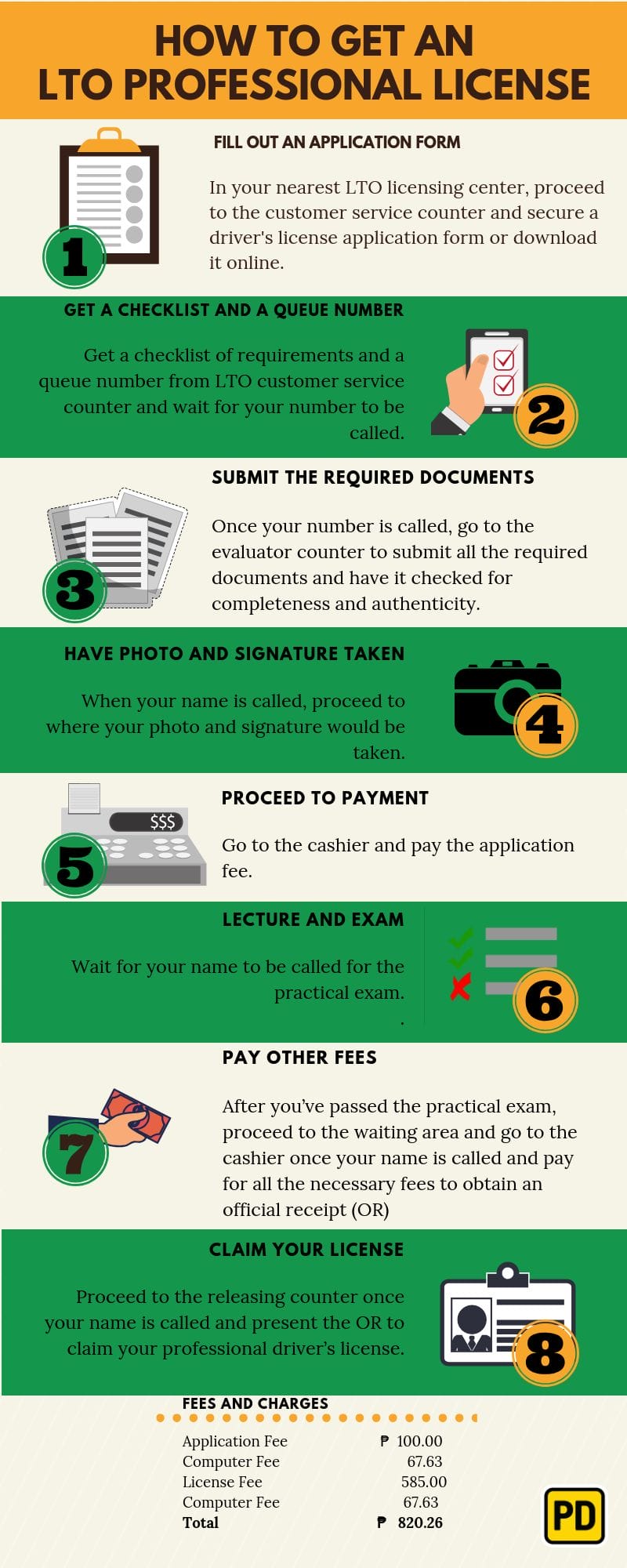
  1. In your nearest LTO licensing center, proceed to the customer service counter and secure a driver’s license application form. You can also download the ADL form here and have it filled out before transacting to any LTO office.
  2. Get a checklist of requirements and a queue number from LTO customer service counter and wait for your number to be called.
  3. Once your number is called, go to the evaluator counter to submit all the required documents and have it checked for completeness and authenticity.
  4. When your name is called, proceed to where your photo and signature would be taken.
  5. Go to the cashier and pay the application fee.
  6. Wait for your name to be called for the practical exam.
  7. After you’ve passed the practical exam, proceed to the waiting area and go to the cashier once your name is called and pay for all the necessary fees to obtain an official receipt (OR)
  8. Proceed to the releasing counter once your name is called and present the OR to claim your Professional driver’s license.

If it makes it easier for you, here’s an infographic:

Infographic of how to get lto pro license

Venue

Any licensing center and district/extension office that accepts new driver’s license transactions.

Fees and charges

Fees and chargesAmount in Php
Application fee₱100.00
Computer fee₱67.63
License fee585.00
Computer fee₱67.63
Total₱820.26

Frequently Asked Questions

Yes, but only if your license is a Professional drivers license as there are three types of driver licenses in the Philippines:

  1. Student Permit license
  2. Non-professional license
  3. Professional license

A professional driver’s license is an official document that authorizes a person to drive public utility vehicles (PUV) such as tricycle, taxi, jeepney, bus, truck, or become a chauffeur for any lucrative purpose.

The total cost of a student permit is ₱820.26.

Tagged with:
Posted in Advice, Car, Driver's license requirements

How to Get an LTO Student Permit: Requirements, Qualifications, and Steps – How to get an LTO Professional driver’s license – 2025

Do you want to drive your own vehicle?

If so, you’ll need to have a driver’s license. To get a driver’s license the first step is to get a Student Permit and to do that you’ll need to know what LTO Student License requirements are.

Why is it needed?

An LTO Student Permit will enable you to practice driving and eventually apply for a driver’s license. If you’re looking forward to having your own Student Permit then see the qualifications, requirements, and procedures below.

LTO Student License Requirements

QUALIFICATIONS you need to apply for a Student Permit license

  1. Must be at least 16 years old
  2. Must be physically and mentally fit to operate a motor vehicle
  3. Must be literate in either Filipino or English

REQUIREMENTS you need for a Student Permit license application for 2019

  1. Filled out driver’s license application form (ADL) [Download ADL form here]
  2. Birth Certificate (Original and photocopy)
  3. If you are under 18 years old: an original copy of parental/guardian consent and original and photocopy of any (1) valid Government-issued ID with signature of your consenting parent/guardian
  4. Medical Certificate (hard copy) stating that you are physically and mentally fit to drive a vehicle. This must be issued by an accredited LTO medical clinic and registered physician. (A copy of the certificate must be electronically uploaded by the clinic/physician to the LTO IT system)

 Note: 

  1. If a birth certificate is unavailable, any of the two will suffice:
  • Joint affidavit of two disinterested persons who know the applicant and who can attest to his/her age and identity accompanied by non-availability of record from NSO or local civil registry office.
  • Any legal document to prove his age and identity (e.g. GSIS, SSS, Passport or any government issued ID)
  1. Applicants below 18 years old need a parent’s or guardian’s written consent with a photocopy of an ID card as proof of identity. The written consent must be notarized if the parent or guardian is not available.

STEPS and PROCEDURES to obtain a Student license 

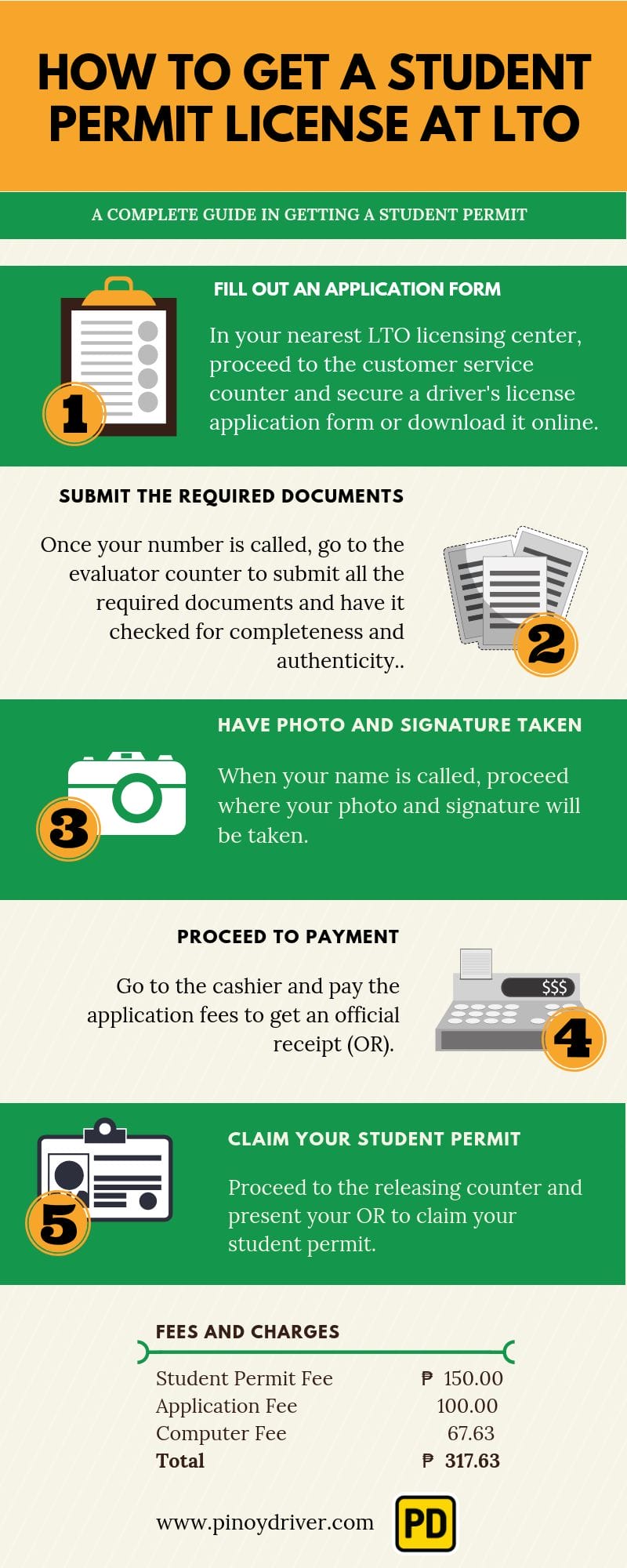
  1. In your nearest LTO licensing center, proceed to the customer service counter and secure a driver’s license application form. You can also download the LTO student permit form (ADL form here) and have it filled out before transacting to any LTO office.
  2. Once your number is called, go to the evaluator counter to submit all the required documents and have it checked for completeness and authenticity.
  3. When your name is called, proceed to where your photo and signature would be taken.
  4. Go to the cashier and pay the application fees to obtain an official receipt (OR)
  5. Proceed to the releasing counter and present the OR to claim your student driver’s permit.

If it makes it easier for you, here’s an infographic:

Infographic of steps to get a LTO student permit

Venue

Any licensing center and district/extension office that accepts new driver’s license transactions.

Fees and charges

Fees and chargesAmount in Php
Student Permit fee₱150.00
Application fee₱100
Computer fee₱67.63
Total₱317.63

What happens next?

An LTO Student Permit has a one year validity period. This gives you ample time to hone and practice your driving skills, learn the road signs and traffic rules, and prepare for the LTO Driving Test.

Bear in mind:

Applicants who fail the Basic Driving Theory Test and/or the Practical Driving Test twice shall not be allowed to apply for the same within a period of 1 year. An applicant who fails either of the tests for the third time will not be allowed to apply for a period of 2 years.”

So be sure to:

Take your actual and written driving lessons by heart. To help you pass the LTO written exam, you can use our free English reviewer and Tagalog reviewer.

We wish you luck in your journey. We hope that you’ll get your non-professional or professional driver’s license.

Drive safely!

Frequently Asked Questions

Answer: The total cost of a student permit is ₱317.63.

Answer: Yes, but you can only drive under the supervision of at least a non-pro license holder.

Answer: You must be at least 16 years old to qualify for a student permit license.

Answer: No, you don't have to take any test to get a student permit.

Answer: A student permit license is only valid for one year.

Answer: Yes, a student permit is a valid ID.

Answer: You may bring any of the following.

  • Joint affidavit of two disinterested persons who know the applicant and who can attest to his/her age and identity accompanied by non-availability of record from NSO or local civil registry office.
  • Any legal document to prove his age and identity (e.g. GSIS, SSS, Passport or any government issued ID)

Tagged with: ,
Posted in Advice, Car, Driver's license requirements

Pin It on Pinterest